P2s at AUA2026: Trials with the power to change practice
From prostate and bladder cancer to kidney stone treatment, these practice-changing studies delivered some of the meeting's most compelling data.
The Practice-Changing, Paradigm-Shifting Clinical Trials in Urology (P2s) series highlights emerging evidence with the potential to reshape patient care. At AUA2026, several presentations challenged conventional approaches and offered new insights into the management of prostate cancer, bladder cancer and urinary stone disease.
In prostate cancer, updated results from a phase 3 trial evaluating extended pelvic lymph node dissection (EPLND) versus limited pelvic lymph node dissection (LPLND) during radical prostatectomy revealed a durable benefit for patients with higher-grade disease. More than 10 years after treatment, patients with ISUP grade 3-5 tumors who underwent EPLND experienced improved biochemical recurrence-free survival and delayed need for additional therapies. “As previously published, this randomized phase 3 trial did not demonstrate oncologic superiority of EPLND over LPLND among unselected intermediate and high-risk prostate cancer patients,” said Jean F.P. Lestingi, MD, PhD, though the updated analysis identified a meaningful benefit in the highest-risk subgroup. Dr. Lestingi is an assistant professor of urology at the Instituto de Cancer do Estado de São Paulo.
In bladder cancer, five-year follow-up from the POTOMAC trial continued to support the addition of durvalumab to BCG for patients with high-risk non-muscle invasive bladder cancer. Investigators reported sustained improvements in disease-free survival, delayed cystectomy and encouraging overall survival trends, making it the longest-running NMIBC trial to date.
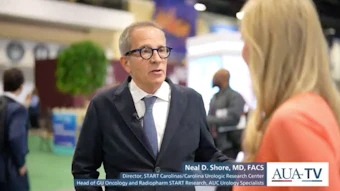
“These data clearly support one year of durvalumab with induction maintenance of BCG as a potential new treatment with high-risk NMIBC,” said Neal Shore, MD, medical director of the START Carolinas/Carolina Urologic Research Center in Myrtle Beach, South Carolina. “The safety of durvalumab plus BCG in the overall safety population and across papillary subgroups was consistent with the known safety profiles of BCG and durvalumab.”
For stone disease, the SOUND trial challenged the standard lithotripsy paradigm by demonstrating that Break Wave lithotripsy achieved stone clearance rates comparable to shock wave lithotripsy without anesthesia and with no reported adverse events. Most treatments were performed in the clinic, and many patients returned immediately to normal activities. “The SOUND trial met its criteria of being noninferior to shock wave lithotripsy,” said Ben H. Chew, MD, MSc, associate professor of urology at the University of British Columbia in Vancouver, Canada. “It was well tolerated with no anesthesia, with the majority of cases being done in the clinic. We had patients who biked into the clinic, were treated successfully, and biked themselves home.”