Enhancing surgical vision
New AI-driven tools promise real-time guidance, smarter navigation and sharper decision-making in the OR.
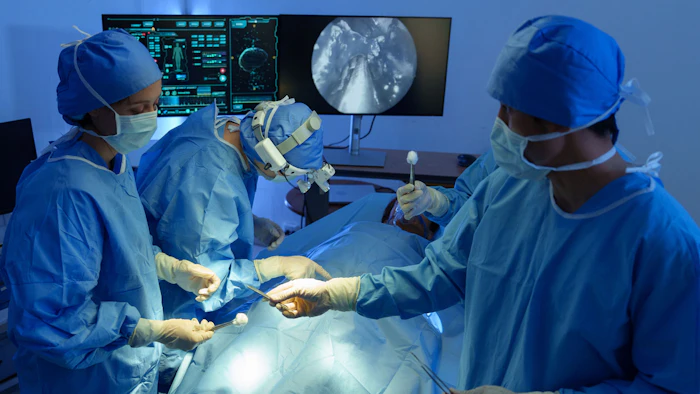
As artificial intelligence continues to reshape medicine, computer vision is emerging as one of the most promising advances in surgical care.
At its core, computer vision transforms the surgical monitor into something far more dynamic than a passive display. By analyzing live endoscopic video in real time, these systems can label urinary tract structures, identify stones or tumors and highlight regions of interest as a case unfolds.
During the State-of-the-Art Lecture: Computer Vision in Endourology, at the 2026 AUA Annual Meeting, Joseph Liao, MD, will explore how these technologies are changing what urologists see—and how they respond—during procedures.
“Computer vision enables automated segmentation and mapping of anatomy, instrument tracking and visualization overlays that align with live video, potentially including 3D reconstructions from video,” said Dr. Liao, who is a professor of urology at Stanford University School of Medicine. “This aids faster and more accurate interpretation during endourologic procedures.”
 Joseph Liao, MD
The impact is already being felt across key applications. In stone surgery, real-time stone localization and segmentation help assess stone burden and can guide decisions around access and fragmentation. “There is also potential for 3D navigation and prediction of stone-free status,” Dr. Liao noted, pointing to a future where intraoperative decision-making is increasingly data-driven.
Similarly, in upper tract urothelial cancer, the technology may enhance tumor detection and delineation. “Computer vision has the potential to enable real-time tumor detection,” he said, offering a tool that could help surgeons identify subtle or difficult-to-visualize lesions.
Looking ahead, Dr. Liao expects continued progress in real-time segmentation across diverse patient populations, moving the field beyond early proof-of-concept and into broader clinical utility.
“AI decision support will increasingly integrate into routine workflows and training,” he said, with scalability driven by prospective validation and real-world studies.
Still, key challenges remain. “Data quality and the ability to apply it across medical centers and devices are major hurdles,” Dr. Liao said, citing the need for prospective validation, regulatory clarity and seamless workflow integration. “Additional concerns are interoperability, usability and trust, data privacy, cost and ongoing maintenance of hardware/software in the operating room.”
Even so, the trajectory is clear. As these technologies mature, computer vision is poised to become an integral part of endourologic practice, reshaping how surgeons see, interpret and ultimately treat disease.