AI: Your new interoperative partner
Artificial intelligence won’t replace surgeons, but surgeons who use it will replace those who don’t.
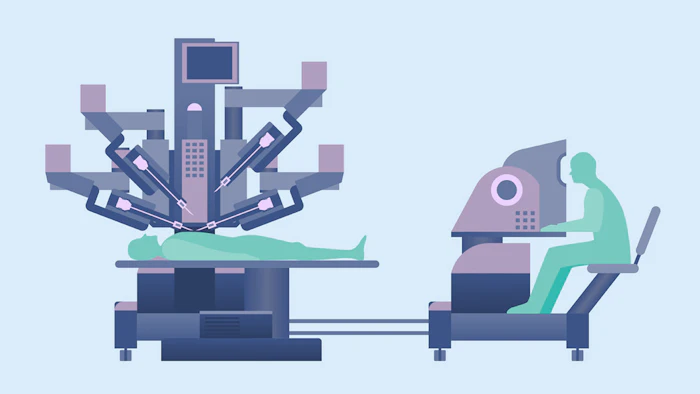
Image-guided robotic surgery was once the stuff of science fiction, but it has become more commonplace in recent years. With the addition of artificial intelligence, augmented reality and 3D imaging, what once seemed far-fetched is now a reality that could provide surgeons with useful tools—provided they learn to adapt.
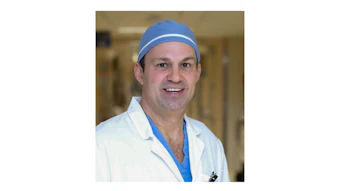
Giovanni Cacciamani, associate professor of urology and radiology at the University of Southern California and director of the Artificial Intelligence Center for Surgical and Clinical Application in Urology at USC, said AI is making inroads in all aspects of the surgical process.
 Giovanni Cacciamani
Dr. Cacciamani will highlight these advances and more in the State-of-the-Art Lecture: Advances in Image-Guided Robotic Surgery at the 2026 AUA Annual Meeting.
The advances in AI and augmented reality imaging don’t stop once the surgery is over, Dr. Cacciamani said.
“AI supports post-operative monitoring and recovery optimization, emphasizing the transition toward a fully integrated, data-driven surgical ecosystem,” he said.
One key advance guided by this new technology is the integration of real-time, AI-driven segmentation and augmented reality into image-guided surgery. Although this is often associated with robotic platforms, Dr. Cacciamani said the technology is broadly applicable to most forms of endoscopic surgery.
“For example, in partial nephrectomy, preoperative imaging can be converted into a 3D model that is overlaid onto the surgical field, while AI continuously updates anatomical structures and recognizes surgical phases during the operation,” he said. “This allows the system to guide the surgeon by highlighting critical structures and optimal dissection planes, improving precision and safety.”
Dr. Cacciamani said this is especially crucial in urological surgery to preserve organ function and reduce complications, though the same principles can be extended to laparoscopic and other minimally invasive approaches.
Although many professions are rightfully concerned about AI replacing human workers, Dr. Cacciamani said surgeons shouldn’t have to worry about that; however, they should look to embrace AI as a valuable tool.
“AI will not replace surgeons, but those of us who will use AI will replace those who don’t,” he said. “And this is true because AI is here to assist us in delivering better care, not to replace us.”
Dr. Cacciamani said AI is evolving into an active interoperative partner rather than just a planning tool, enabling real-time guidance through surgical step recognition, segmentation and navigation. The technology also has the potential to improve safety through preventing and identifying adverse events as they occur, especially in complex surgical scenarios.
“The future of image-guided robotic surgery lies in the development of augmented-intelligent, context-aware systems that can understand surgical workflow, interpret anatomy in real time and provide anticipatory guidance,” he said. “These platforms will increasingly incorporate automated detection of intraoperative adverse events, adaptive navigation in complex or distorted anatomy and partial automation of specific surgical tasks. Over time, they will integrate preoperative, intraoperative and postoperative data into continuous learning systems, ultimately enhancing surgical precision, standardization and patient-specific care.”